Safety Investigation Report 2018:1 Factual Information/1.9/1.9.5 Satcom
SAFETY INVESTIGATION REPORT MH370 (9M-MRO)
1.9.5 Satellite Communications
1) Satellite Communications System Description
Satellite Communications (SATCOM) is an acronym of, and generic term for, satellite communications. SATCOM operates by using satellites to relay radio signals between the sender and receiver. It can cover far more distance and wider areas than other radios. SATCOM can be used to transmit words, pictures and other forms of information.
The aircraft, 9M-MRO, was equipped with a SATCOM terminal that used the Inmarsat Classic Aero system. The Inmarsat system utilises a constellation of satellites to provide nearly global coverage, the exception being polar areas. The aircraft SATCOM system, also referred to as an Airborne Earth Station (AES) operates on L Band, transmits at 1.6 GHz and receives at 1.5 GHz. For this aircraft, the SATCOM system provided a total of five voice channels and one data channel. The satellite link provides the following functions:
The Earth or Ground Station uses C Band, transmits at 6 GHz and receives at 4 GHz. Inmarsat uses a network of Ground Earth Stations (GES) to communicate with the satellites and connect the SATCOM signal to other terrestrial data networks such as telephone systems, internet, etc.
When the SATCOM AES is first powered on, it sends a log-on request to the GES to initiate service.
There are a number of channels available for messages to be sent between the Satellite and Earth Station. One of the channels is called the ‘common access channel’, which aircraft will constantly listen to when able to do so.
If the GES has not heard from an aircraft for an hour after the last communication, it automatically transmits a ‘log on interrogation’ (“ping”) message on the common access frequency using the aircraft’s unique identifier. If the aircraft receives its ‘unique identifier’, it returns a short message that it is still logged onto the network. Both the initial log-on request and the hourly ping have been termed as a ‘handshake'.
The SATCOM AES consists of the following equipment: Radio frequency unit (RFU), Radio frequency attenuator (RF ATTN), Radio frequency splitter (RFS), Class C high power amplifier (HPA), Class A high power amplifier (HPA), High power relay (HPR), three low noise amplifier/diplexers (LNA/DIPs), Low gain antenna (LGA), two beam steering units (BSUs), two high gain antennas (HGAs), Radio frequency combiner (RFC) and Satellite data unit (SDU).
The SATCOM avionics are located on the E11 rack, which is in the crown area aft of doors 3 left/right. The High Gain antennas are mounted above door 3 left and door 3 right. The Low Gain antenna is mounted on the fuselage centreline. The SATCOM Circuit Breakers (CB) are located in the Main Equipment Center (MEC).
The Satellite Data Unit (SDU) receives 115V AC from the Left Main bus. In flight, this bus can be powered by engine mounted generators or the APU generator. Neither the aircraft battery nor the ram air turbine will power the SATCOM system.
The diagram in Figure 1.9K (below) shows the complete set of SATCOM units, including avionics, High Gain Antenna Subsystem and Low Gain Antenna Subsystem. It also shows interfaces to the aircraft cockpit and cabin systems and functions. The following notes are intended to be read in conjunction with Figure 1.9K (below):
- a) CDU (3) are the three Control Display Units, otherwise known as Multi-function Control Display Units (MCDUs).
- b) CPMU is Cabin Passenger Management Unit, which provides an interface between the Panasonic IFE and the SDU, for any Data-3 SMS/e-mail messages.
- c) AMU is the Audio Management Unit, which feeds cockpit audio to and from the SDU.
- d) CTU is the Cabin Telecommunications Unit, which provides an interface between the in-seat handsets and the SDU, for cabin telephony calls, were that functions available. In the case of 9M-MRO, the in-seat phones can only be used for seat-to-seat calling.
- e) AIMS Cabinet is one of two Airplane Information Management System cabinets, which route numerous information to and from the SDU, including ACARS data, Navigational data, AES ID and Flight ID.
- f) SATCOM Maintenance Switch is not relevant to this document, as no maintenance activity is possible in flight.
Figure 1.9K - SATCOM System
The photo in Figure 1.9L (below) shows the Honeywell/Racal (Honeywell/Thales) MCS-6000 SATCOM Units - RFU (left), SDU (centre) and HPA (right).
2) Satellite Communications Ground Station Logs of the Event - Introduction
Throughout the flight of MH370, the aircraft communicated through the Inmarsat Indian Ocean Region (IOR) I-3 Satellite and the GES in Perth, Australia.
Figure 1.9M (below) shows the Inmarsat I-3 IOR Satellite Coverage Map. The blue lines represent the elevation angle to the IOR satellite for a SATCOM unit on the ground or in the air. Due to the satellite inclination, the elevation angles are approximate.
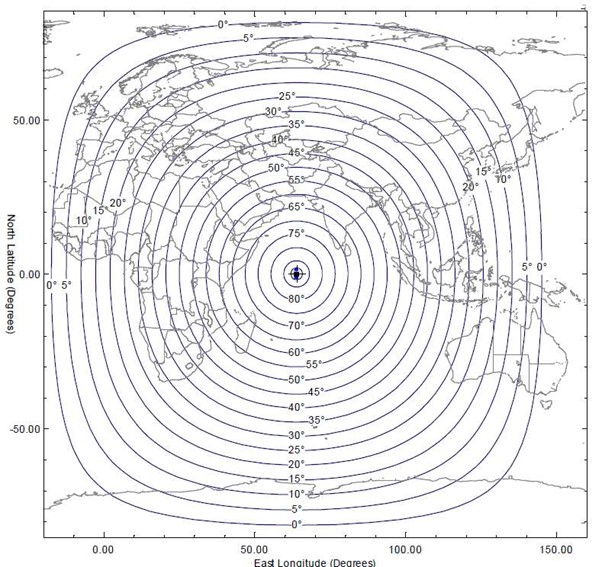
Figure 1.9M - Inmarsat I-3 IOR Satellite Coverage Map
Source:
Safety Investigation Report MH370/01/2018
MH370 departed KLIA at 1642 UTC [0042 MYT, 08 March 2014]. At 1707 UTC, the SATCOM system was used to send a standard ACARS report, normally sent every 30 minutes. The message also indicated the remaining fuel on-board.
The ACARS reports expected at 1737 UTC and 1807 UTC were not received. The next SATCOM communication was a log-on request from the aircraft at 1825 UTC. From that point until 0011 UTC, SATCOM transmissions indicate that the link was available, although not used for any voice, ACARS or other data services apart from two unanswered ground-to-air telephone calls. At 0019 UTC, the AES initiated another log-on request. The log-on acknowledge was the last transmission from the SATCOM.
The SATCOM link was available for most of the flight, excluding a period of between 22 and 78 minutes leading up to 1825 UTC, 07 March and a period of less than 8 minutes leading up to 0019 UTC, 08 March 2014. The absence of any aircraft-initiated handshakes, and on-going success of ground-initiated handshakes, indicates that power to the SATCOM was maintained other than the two periods stated above.
Data from the last seven ‘handshakes’ were used to help establish the most probable location of the aircraft. Initially only the first six of these ‘handshakes’ were considered to be complete. The seventh and last ‘handshake’ that was automatically initiated by the aircraft, was originally assessed as a partial ‘handshake’. Subsequent analysis confirmed the 7th handshake could be used to help determine the most probable flight path. Two unanswered ground-to-air telephone calls had the effect of resetting the activity log and hence increased the period between the ground initiated ‘handshakes’. The significant times used to identify the most probable final location of the aircraft are tabulated in Table 1.9B below. Details of the event’s SATCOM ground station logs are provided in Section 1.9.5 para. 3) and 4) (below).
| SATCOM TRANSMISSIONS | TIME | ||
|---|---|---|---|
| UTC | MYT* | ||
| 1. | Aircraft departed KLIA | 1642 | 0042 |
| 2. | Last ACARS transmission | 1707 | 0107 |
| 3. | 1st handshake - log-on initiated by the aircraft | 1825 | 0225 |
| 4. | Unanswered ground-to-air telephone call | 1839 | 0239 |
| 5. | 2nd handshake initiated by ground station | 1941 | 0341 |
| 6. | 3rd handshake initiated by ground station | 2041 | 0441 |
| 7. | 4th handshake initiated by ground station | 2141 | 0541 |
| 8. | 5th handshake initiated by ground station | 2241 | 0641 |
| 9. | Unanswered ground-to-air telephone call | 2313 | 0713 |
| 10. | 6th handshake initiated by ground station | 0011* | 0811 |
| 11. | 7th handshake - log-on initiated by the aircraft | 0019* | 0819 |
| 12. | Aircraft did not respond to ‘handshake’ from Satellite Earth Ground Station | 0115* | 0915 |
| *08 March 2014 | |||
Table 1.9B - SATCOM ‘Handshakes’
3) Satellite Communications Ground Station Logs of the Event - Summary
The SATCOM utilised the Inmarsat Indian Ocean Region (IOR) I-3 satellite and the associated Perth Ground Earth Station (GES) throughout the flight. Inmarsat has confirmed that during the flight, no SATCOM signalling or traffic was routed via any other satellites (including MTSAT) to any other GESs (including MTSAT11 GESs).
________________________
11 MTSAT - A series of Japanese weather and aviation satellites and GESs. MTSAT-1R and MTSAT-2 satellites are interoperable with Inmarsat satellites.
The SATCOM provides the Satellite link for the following functions:
- Cockpit Voice - Call control via the Multi-function Control and Display Units (MCDUs) and audio via the cockpit Audio Management Unit (AMU) and associated headsets;
- Cockpit Packet Data (Data-2) - Interface via the ACARS Management Unit (MU); and
- Cabin Packet Data (Data-3) - Interface via the Panasonic System 3000i IFE equipment:
The GES logs contain the following key information for each transmission to and from the aircraft:
- Time tag, Satellite and GES (Note: the timestamp accuracy does vary between the different logs, but should always be <1 second, and usually to a few milliseconds);
- Channel Type, Channel Number (frequency), Received Carrier/Noise Density Ratio (C/No), channel Bit-Error-Rate (BER), Burst Frequency Offset (BFO) and Burst Timing Offset (BTO, or round trip delay); and
- All payload data (excluding voice frames) contained within the transmission - these are known as the Signal Unit contents.
The events are summarised below. All times are in UTC. In the summary below, times are truncated to the nearest minute (the format is Hours Minutes) and in Section 1.9.5 para. 4), times are truncated to the nearest second (the format is Hours Minutes:Seconds).
| No. | Summary of SATCOM Ground Station Logs |
|---|---|
| 1. | Prior to take-off, the SATCOM Logged On (normally) a number of times, the last time being at 1600, when it sent a valid Flight ID to the GES. The SATCOM link was available for both voice and data (known as Log-On Class 3). |
| 2. | After take-off, the IFE SMS email application sent a normal beginning-of-flight message at 1642 (containing the correct Airborne Earth Station [AES ID], Flight ID "MAS370", origin airport "WMKK", and destination airport "ZBAA"), indicating that the IFE was receiving the valid Flight ID, origin airport and destination airport from AIMS and the ICAO (AES) ID from the Satellite Data Unit (SDU) at this time. |
| 3. | The SATCOM link was available for most of the flight, excluding periods leading up to 1825 UTC, 07 March and 0019 UTC, 08 March 2014. |
| 4. | When the SATCOM link was re-established at the above times, no Flight ID was present |
| 5. | During each of the two in-flight Log Ons at 1825 UTC and 0019 UTC, the GES recorded abnormal frequency offsets for the burst transmission from the SATCOM. |
| 6. | There is no indication of the SATCOM link being manually Logged Off from the cockpit (via an MCDU). Such activity would have been captured in the GES logs, but it was not. |
| 7. | No Data - 2 ACARS traffic was observed after 1707 UTC 07 March 2014. |
| 8. | The IFE equipment set up two ground connections over SATCOM [for the SMS e-mail application and Built-In Test Equipment (BITE) application] after the SATCOM reestablished the link at 1825 UTC, 07 March 2014 (normal), but not after the SATCOM re-established the link at 0019 UTC, 08 March (abnormal). At no time during the flight was any user data sent over the link by means of the SMS/e-Mail application. |
| 9. | Two Ground-to-Air Telephone Calls were placed to the cockpit from MAS Operations Centre (MOC) at Airline Operational Communications (AOC) Q10 priority level at 1839 UTC and at 2313 UTC, 07 March 2014. Neither of the calls was answered. |
| 10. | The SATCOM responded normally to a series of roughly hourly Log-On Interrogations from the Perth GES, up to and including a Log-On Interrogation at 0011 UTC, 08 March 2014. The two unanswered ground to air calls at 1839 UTC and 2313 UTC reset the Perth GES inactivity timer and hence the LogOn Interrogations were not always hourly. |
| 11. | The last transmission received from the SATCOM occurred at 0019 UTC, 08 March 2014 and the SATCOM failed to respond to a series of three Log-On interrogations starting at 0115 UTC, 08 March 2014. |
4) Satellite Communications Ground Station Logs – Key Observations (in chronological order) (Table 1.9C [below])
| No. | Time (UTC) | Key Observations - Satellite Ground Station Logs |
|---|---|---|
| 1. | 1250:19 | Prior to take-off, the SATCOM initiates a normal Log-On as Class 1 (data only capable) via the Pacific Ocean Region (POR) I-3 satellite, using the Low Gain Antenna (LGA) subsystem, suggesting that ADIRU (Air Data Inertial Reference Unit) navigation data was not available to the SDU at this time. No flight ID is sent to the GES at this time. This is the first SATCOM activity recorded at the GES since 0802:27, suggesting that the SATCOM was not powered for a period of several hours, whilst the aircraft was on ground. This is quite normal. |
| 2. | 1555:57 | The SATCOM initiates a normal Log On Renewal as Class 1 (data only capable) via the POR I-3 satellite, using the LGA subsystem, this time with a valid Flight ID. |
| 3. | 1557:49 | The SATCOM initiates a normal Log-On as Class 3 (voice and data capable) via the POR I-3 satellite, using the High Gain Antenna (HGA) subsystem, with a valid Flight ID. This suggests that the ADIRU derived navigation data has become available at this time. |
| 4. | 1559:57 | The SATCOM initiates a Log-On handover as Class 3 (voice and data capable) to the IOR I-3 satellite, using the HGA subsystem, with a valid Flight ID. This suggests that the IOR is now considered to be the best available satellite. This is probably because either the line of sight to the IOR satellite is now clearer than that to the POR satellite, or the antenna gain in the direction of the IOR satellite has become higher than the antenna gain in the direction of the POR satellite. |
| 5. | 1642:04 | After take-off, the IFE SMS e-mail application sends a normal beginning-of-flight message. |
| 6. | 1707:48 | Last DATA-2 ACARS Message received at the GES. No further SATCOM Data-2 ACARS messages or acknowledgements were received at the GES for the remainder of the flight. This is abnormal and suggests that the on-board ACARS equipment either failed, or was disabled or powered down at some time between 1707:48 and around 1825:00. |
| 7. | 1803:41 | GES initiates a DATA-2 ACARS transmission (uplink), but receives no acknowledgement from the SATCOM.
|
| 8. | 1805:11 | GES initiates a DATA-2 ACARS transmission, but receives no acknowledgement from the SATCOM, indicating that there is still no SATCOM link at this time. |
| 9. | 1825:27 | SATCOM Log-On, initiated from the aircraft terminal.
|
| 10. | 1825:34 | SATCOM Log-On, successfully completed.
An OCXO provides a stable reference frequency for the SDU Radio Frequency (RF) transmit and receive circuits and also for SDU modem timing. Within the OCXO, a regulated oven keeps the crystal at an almost constant temperature if the ambient temperature in the crown area is between the ranges -55oC up to above +70oC. The oven also contains extra electrical regulation and isolation to ensure frequency accuracy and stability. The OCXO includes an oven ready flag, which triggers the Log-On initiation when the OCXO reaches its operating temperature. Extensive laboratory testing has revealed that during warm up, the OCXO frequency may vary non-linearly with time, but then settles with almost negligible variation. At power-on, the OCXO can exhibit either a rising or falling frequency gradient, before decaying over time to its normal steady state value. The testing has indicated that reasonable stability (within 2Hz/minute) is typically reached by around five minutes after an initial peak or overshoot. The testing has also shown that there can still be a significant frequency offset at the time that the oven ready flag initiates the Log-On process, so the Log-On request, Log-On Acknowledge and subsequent data bursts can all exhibit significant frequency offsets. |
| 11. | 1827:03 | The IFE sets up a Data-3 ground connection (X.25 circuit) over SATCOM for an SMS/e-mail application after the SATCOM link is re-established. |
| 12. | 1828:05 | The IFE sets up a Data-3 ground connection (X.25 circuit) over SATCOM for a BITE application after the SATCOM link is re established. |
| 13. | 1839:52 | Ground-to-air telephony call placed from a number with country code 60 (Malaysia)
|
| 14. | 1840:56 | The GES logs show that the unanswered Ground-to-Air telephony call was cleared by the calling party. |
| 15. | 1941:00 | Log-On Interrogation by the Perth GES, with a response from the SATCOM |
| 16. | 2041:02 | Log-On Interrogation by the Perth GES, with a response from the SATCOM |
| 17. | 2141:24 | Log-On Interrogation by the Perth GES, with a response from the SATCOM |
| 18. | 2241:19 | Log-On Interrogation by the Perth GES, with a response from the SATCOM |
| 19. | 2313:58 | Ground-to-air telephony call placed from a number with country code 60 (Malaysia)
|
| 20. | 2315:02 | The GES logs show that the unanswered Ground to Air telephony call was cleared by the calling party. |
| 21. | 0010:58 | Log-On Interrogation by the Perth GES, with a response from the SATCOM |
| 22. | 0019:29 | SATCOM Log-On, initiated from the aircraft terminal. This is the seventh ‘handshake’.
|
| 23. | 0019:37 | SATCOM Log-On, successfully completed
Note: This is the last transmission received from the aircraft terminal. |
| 24. | 0115:56 | Log-On Interrogation by the Perth GES, with no response from the SATCOM |
| 25. | 0116:06 | Log-On Interrogation by the Perth GES, with no response from the SATCOM. |
| 26. | 0116:15 | Log-On Interrogation by the Perth GES, with no response from the SATCOM. |
Table 1.9C - Chronology of Satellite Communications Ground Station Logs
5) Frequencies of Log-On Bursts
During each of the two in-flight Log-Ons that occurred at 1825 and 0019, the GES recorded abnormal frequency offsets for the SATCOM transmissions. This is in contrast with the ‘normal’ Log-On behaviour.
Table 1.9D (below) shows the frequencies of these Log-On bursts, as measured at the GES, plus differences from assumed reference frequencies (closest stable values in time, where the aircraft is assumed to be in level flight). The table also shows the very high delta frequencies between the respective Log-On Request and Log-On Acknowledge bursts.
| Log-On Time | 1825 | 0019 |
|---|---|---|
| BFO used as a reference (closest stable value, assume level flight) | 144Hz @ 1828:05 | 252Hz @ 0010:59 |
| Log-On Request BFO | 142Hz @ 1825:27 | 182Hz @ 0019:29 |
| Log-On Request C/No recorded at GES | 30.28 | 40.59 |
| Log-On Request Channel BER recorded at GES | 5 | 0 |
| Log-On Request Difference Frequency (from BFO reference) | -2Hz @ 1825:27 | -70Hz @ 0019:29 |
| Log-On Acknowledge BFO | 273Hz @ 1825:34 | -2Hz @ 0019:37 |
| Log-On Acknowledge C/No recorded at GES | 42.55 | 43.38 |
| Log-On Acknowledge Channel BER recorded at GES | 0 | 0 |
| Log-On Acknowledge Difference Frequency (from BFO reference) | +129Hz @ 1825:34 | -254Hz @ 0019:37 |
| Delta frequency between the Log-On Request and the Log-On Acknowledge bursts, plus time period | +131Hz over 7 seconds | -184Hz over 8 seconds |
Table 1.9D - Log-On Bursts